

What Size Parking Space Do You Need for a Trailer, Boat, or RV?
The right parking space for a trailer, boat, or RV depends on its overall length, width, and height, including the hitch, tongue, motor, spare tire, and other attachments. For example, a 27-foot travel trailer has 3 feet of total length allowance in a 30-foot parking space. But fitting inside the marked dimensions is only part of the decision. You also need enough room to enter, park, and retrieve your vehicle.
This guide explains how to measure your equipment, compare parking-space sizes, and explore vehicle parking options at select SteelSafe Self Storage locations, including indoor vehicle parking in Erie, Pennsylvania.
How Much Parking Space Do You Need?
Start by measuring the complete vehicle in the condition it will be stored. Then compare those measurements with the parking space’s listed dimensions.
A space that is longer and wider than your vehicle may be worth considering, but the final choice also depends on the parking layout, access route, and facility rules.
Here are three practical examples.
A 27-Foot Travel Trailer in a 30-Foot Space
A 27-foot trailer leaves 3 feet of total length allowance in a 30-foot space.
That may provide some room around the trailer, but you still need to consider its width and how the tow vehicle will approach the stall.
An 8.5-Foot-Wide Trailer in a 10-Foot-Wide Space
An 8.5-foot-wide trailer leaves 18 inches of total width allowance in a 10-foot-wide space.
If centered, that’s approximately 9 inches on either side. The trailer may physically fit, but maneuvering and side access could be limited.
A 34-Foot Boat Trailer in a 35-Foot Space
A 34-foot boat-and-trailer combination leaves just 1 foot of total length allowance in a 35-foot space.
A longer parking space may offer more flexibility, especially if you need room to position or access the equipment.
These calculations help you compare options, but they do not guarantee that a particular vehicle can be parked safely in a specific stall.
How to Measure Your Trailer, Boat, or RV
Travel Trailers: Measure Beyond the Trailer Body
Measure from the frontmost point of the coupler to the rearmost fixed attachment. Include the trailer tongue, spare tire, bumper, cargo rack, or anything else extending beyond the body.
Check the widest point, including fenders and fixed accessories. Measure height from the ground to the highest rooftop equipment.
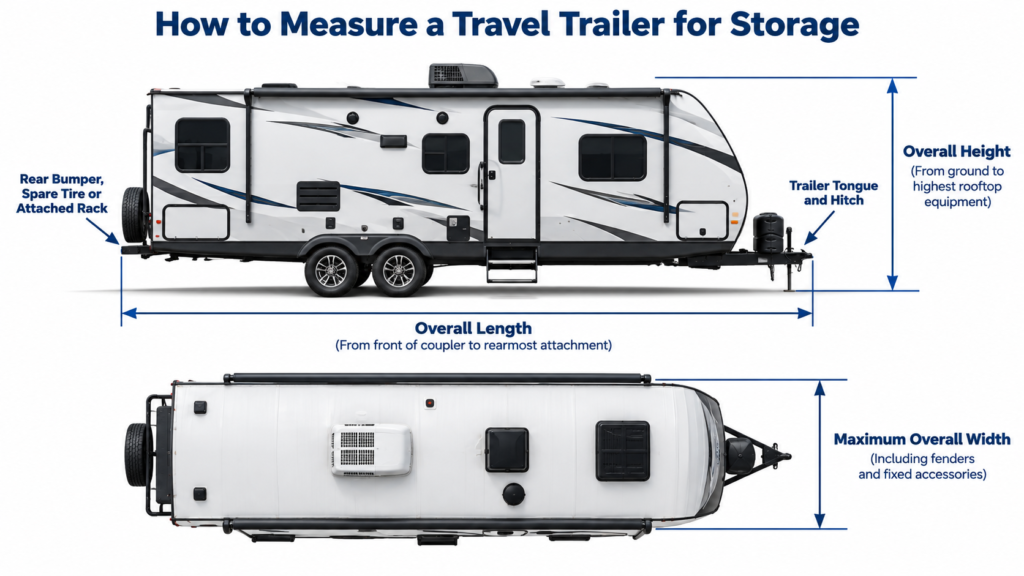
Measure the entire travel trailer, including the tongue, coupler, rear attachments, and rooftop equipment—not just the trailer body.
Does Trailer Length Include the Hitch?
Not always. Manufacturers may advertise body length, floor-plan length, or overall length.
For conventional travel trailers, the tongue and coupler can add length beyond the advertised body measurement. For utility and enclosed cargo trailers, include the tongue, loading gate, and other projections.
For fifth-wheel trailers, measure the complete parked trailer, including the front overhang and rear attachments.
The safest measurement is the complete parked footprint, not the model number.
Boats: Measure the Trailer and the Motor
For a boat-and-trailer combination, measure from the front of the trailer coupler to the furthest rear projection. This may be the outboard motor, swim platform, or trailer hardware.
Measure the widest point of the boat or trailer, whichever extends farther.
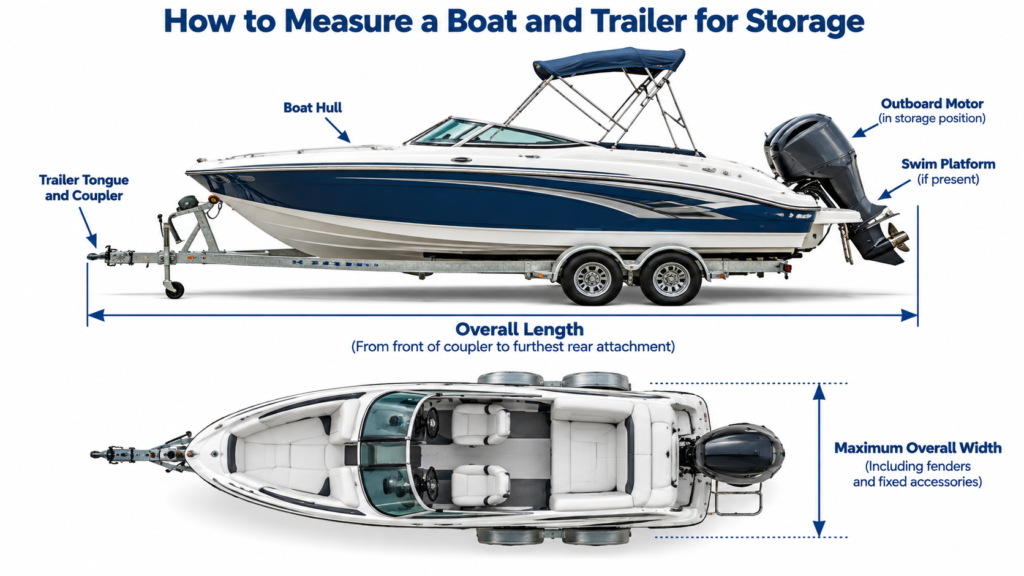
Measure the complete boat-and-trailer combination, including the trailer tongue, coupler, outboard motor, and any swim platform or rear attachment.
RVs and Motorhomes: Check Length, Width, and Height
Measure the RV from its frontmost to rearmost fixed points, including attached equipment. Check its widest projections and the height of rooftop air-conditioning units or other equipment.
Height is particularly important when considering indoor parking.
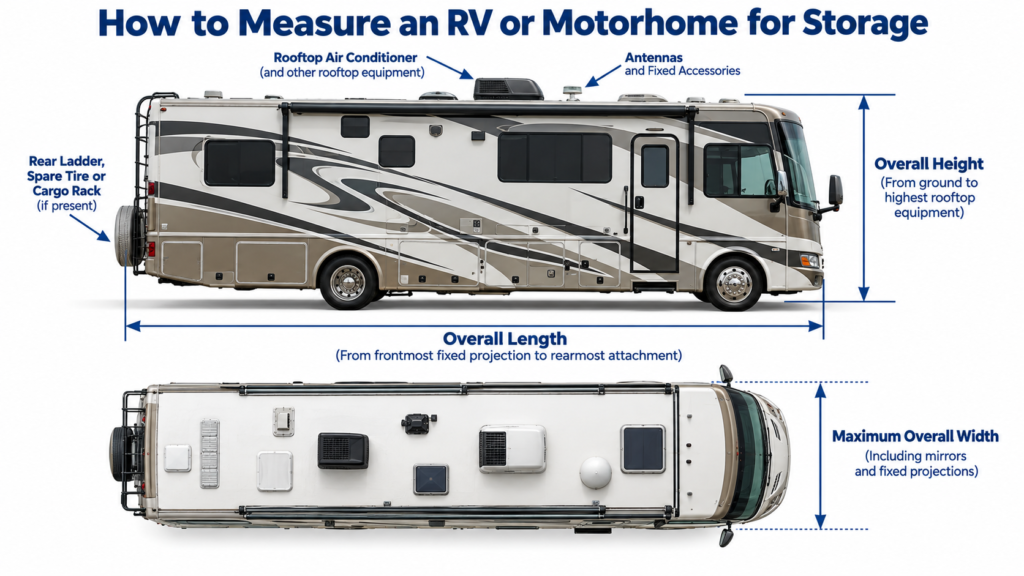
Check your RV’s full front-to-rear length, widest fixed projections, and tallest rooftop equipment before comparing parking-space dimensions.
Why Parking Layout Matters
A trailer may fit within the marked parking space but still be difficult to maneuver into position.
The tow vehicle needs room to turn, straighten, and back the trailer into the stall. Drive-aisle width, parking angle, trailer wheelbase, and nearby obstacles can all affect the approach.
This is especially important when comparing angled parking and 90-degree parking.
Angled spaces can offer a different entry approach than perpendicular spaces. However, the easiest option depends on the vehicle, the aisle, and the driver’s maneuvering needs.
Before renting, consider how you will enter the property, approach the stall, park, unhitch if necessary, and leave.
Indoor vs. Outdoor Vehicle Parking
Different parking arrangements offer different advantages.
Uncovered parking provides an outdoor space without overhead shelter.
Covered parking provides overhead protection, but the roof and support structures may affect clearance.
Indoor parking places the vehicle inside a building. Entrance dimensions, interior clearance, and the parking layout are important considerations.
Indoor Vehicle Parking at SteelSafe Erie, PA
SteelSafe Erie offers 12′ × 20′ indoor vehicle parking with two parking configurations:
- 45° Angled Easy-Access: An angled layout designed for a convenient parking approach.
- 90° Parking: A perpendicular parking layout for vehicles that can comfortably enter and exit the space.
Both options are indoor vehicle parking. Choosing between them depends on your vehicle’s measurements and the maneuvering room you need.
SteelSafe Erie also publishes 6 AM–8 PM access hours, seven days a week.
For customers comparing monthly indoor vehicle parking with traditional seasonal storage, regular access can be a meaningful benefit. Instead of leaving a vehicle inaccessible for months under a seasonal arrangement, customers can choose a parking option that better suits how frequently they expect to use their vehicle.
Check the specific rental terms and access arrangements for your selected space before renting.
For indoor parking, also confirm that your vehicle fits through the building entrance and along the interior access route. A 12′ × 20′ stall does not automatically mean every vehicle within those dimensions can enter the building.
SteelSafe Erie
2001 E 12th St, Erie, PA 16511
Phone: (814) 476-6555
Explore SteelSafe Erie Indoor Vehicle Parking
SteelSafe Parking Sizes by Location
SteelSafe offers vehicle parking at select locations. The table below lists parking products separately from other large drive-up storage listings.
| SteelSafe Location | Parking Space Size | Published Parking Type |
| Bally, PA | 12′ × 50′ | Parking / Drive Up |
| Erie, PA | 12′ × 20′ | Indoor Vehicle Parking — 45° Angled Easy-Access and 90° Parking |
| Hamburg Grand Street, PA | 10′ × 20′, 12′ × 50′, 12′ × 80′ | Uncovered Parking |
| Mt. Wolf, PA | 12′ × 50′ | Uncovered Parking |
| Pottstown, PA | 9′ × 20′ | Parking / Drive Up |
| Granby, CO | 11′ × 35′ | Uncovered Parking |
Some facilities also advertise larger spaces under Medium / Drive Up rather than Parking. These include Bally’s 10′ × 30′, Hamburg Grand Street’s 11′ × 30′, and Pottstown’s 10′ × 35′ listings. Their suitability for vehicle parking depends on the individual rental product and facility rules.
Parking dimensions describe advertised space sizes, not guaranteed current vacancies or vehicle fit.
RV and Trailer Parking at SteelSafe Hamburg
SteelSafe’s Grand Street location in Hamburg, Pennsylvania, offers outdoor parking options for permitted vehicles, including larger spaces for longer equipment.
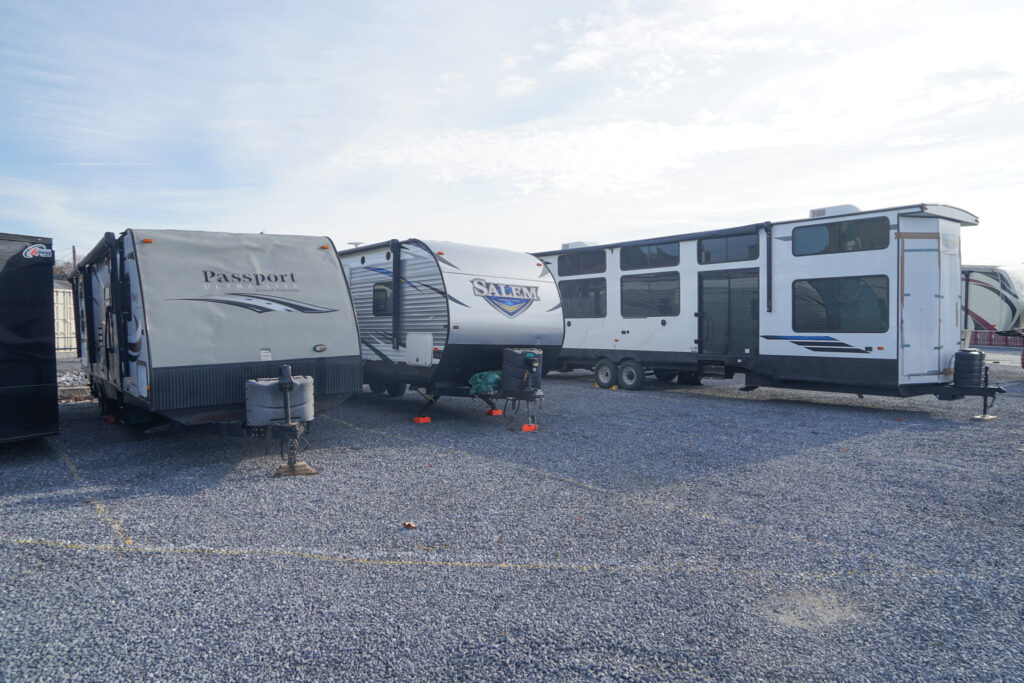
RV and trailer parking at SteelSafe’s Hamburg location. Measure the full length of your vehicle, including the hitch and attached accessories, before reserving a space.
The facility’s actual parking photographs show why measuring the complete trailer matters. Hitches, tongues, and other attachments can extend beyond the main body and affect the space required.
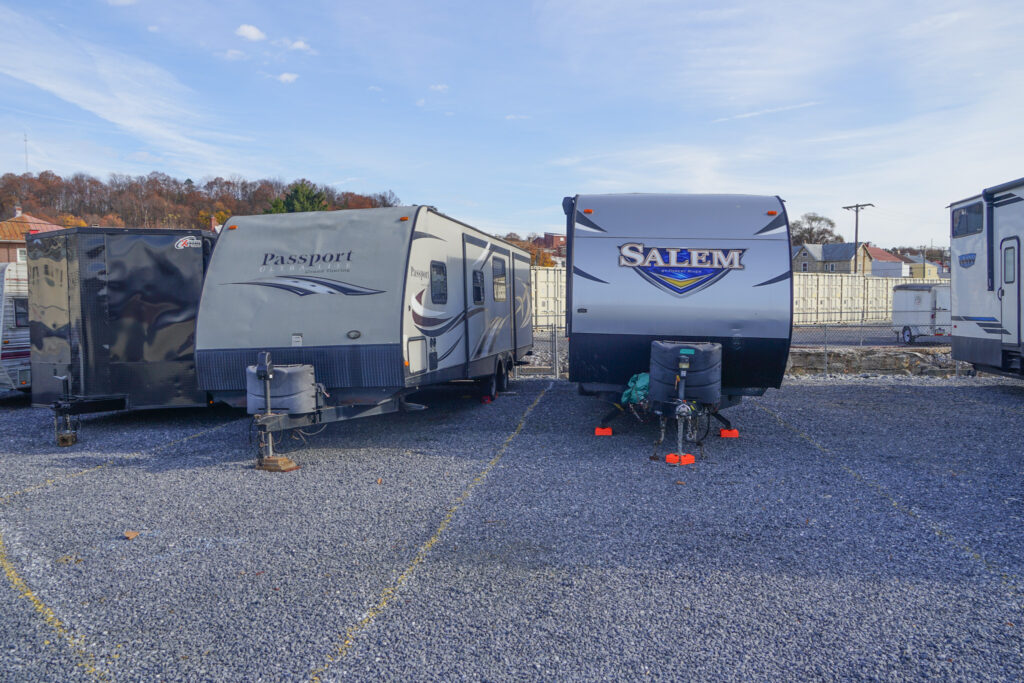
Trailers parked at SteelSafe Hamburg. Consider the parking layout and available maneuvering room, not just the listed space dimensions.
When comparing parking options, consider both the marked dimensions and the room needed to approach and retrieve your vehicle.
SteelSafe Hamburg Grand Street
251 Grand St, Hamburg, PA 19526
Phone: (484) 247-4766
Explore Hamburg Grand Street Parking
What to Check Before Renting a Parking Space
Before choosing a space, have these details ready:
- Overall vehicle length, including attachments
- Maximum width
- Maximum height
- Vehicle or trailer type
- Whether the tow vehicle will remain parked
- Preferred SteelSafe location
Also review the property’s access hours, permitted vehicle types, and parking layout. For indoor parking, check entrance and interior clearances.
Frequently Asked Questions
What size parking space do I need for a 25-foot travel trailer?
If 25 feet is the complete overall length, a 30-foot space provides 5 feet of total length allowance. Check the trailer’s width and the parking layout before choosing.
Does trailer length include the tongue or hitch?
Not always. Advertised trailer measurements vary. Measure from the frontmost coupler to the rearmost attachment to determine the full parking footprint.
Will a 30-foot RV fit in a 30-foot parking space?
A 30-foot RV in a 30-foot space would have no extra length allowance. A longer space may be more practical, particularly if accessories extend beyond the body.
Does SteelSafe Erie offer indoor vehicle parking?
Yes. SteelSafe Erie offers 12′ × 20′ indoor vehicle parking, including 45° angled easy-access and 90° parking configurations. Check the vehicle’s dimensions and building entrance clearance before renting.
Can I park a truck and trailer together?
That depends on the selected space, the complete dimensions of the combination, and the facility’s permitted uses. Ask about the specific parking product before renting.
How can I check whether a parking space is available?
Visit the relevant SteelSafe location’s website to review its current rental listings. You can also contact the facility for help comparing space sizes and parking configurations.
Find the Right Parking Space at SteelSafe
Choosing the right parking space starts with accurate measurements and an understanding of how you will park and retrieve your equipment.
SteelSafe offers vehicle parking at select facilities, including indoor vehicle parking in Erie, Pennsylvania, and outdoor options at other locations.
If you already know your vehicle’s complete dimensions, explore the available parking options at your preferred location.
Explore SteelSafe Boat and RV Storage
If you’re unsure which space is appropriate, contact your preferred SteelSafe facility with your vehicle’s overall length, width, and height. Our team can help you review the listed options and important fit considerations before you rent.
Ready to Reserve a Self Storage Unit?
Additional Resources

How Quickly Can I Get Into My Storage Unit After Renting Online?
How Quickly Can I Get Into My Storage Unit After [...]
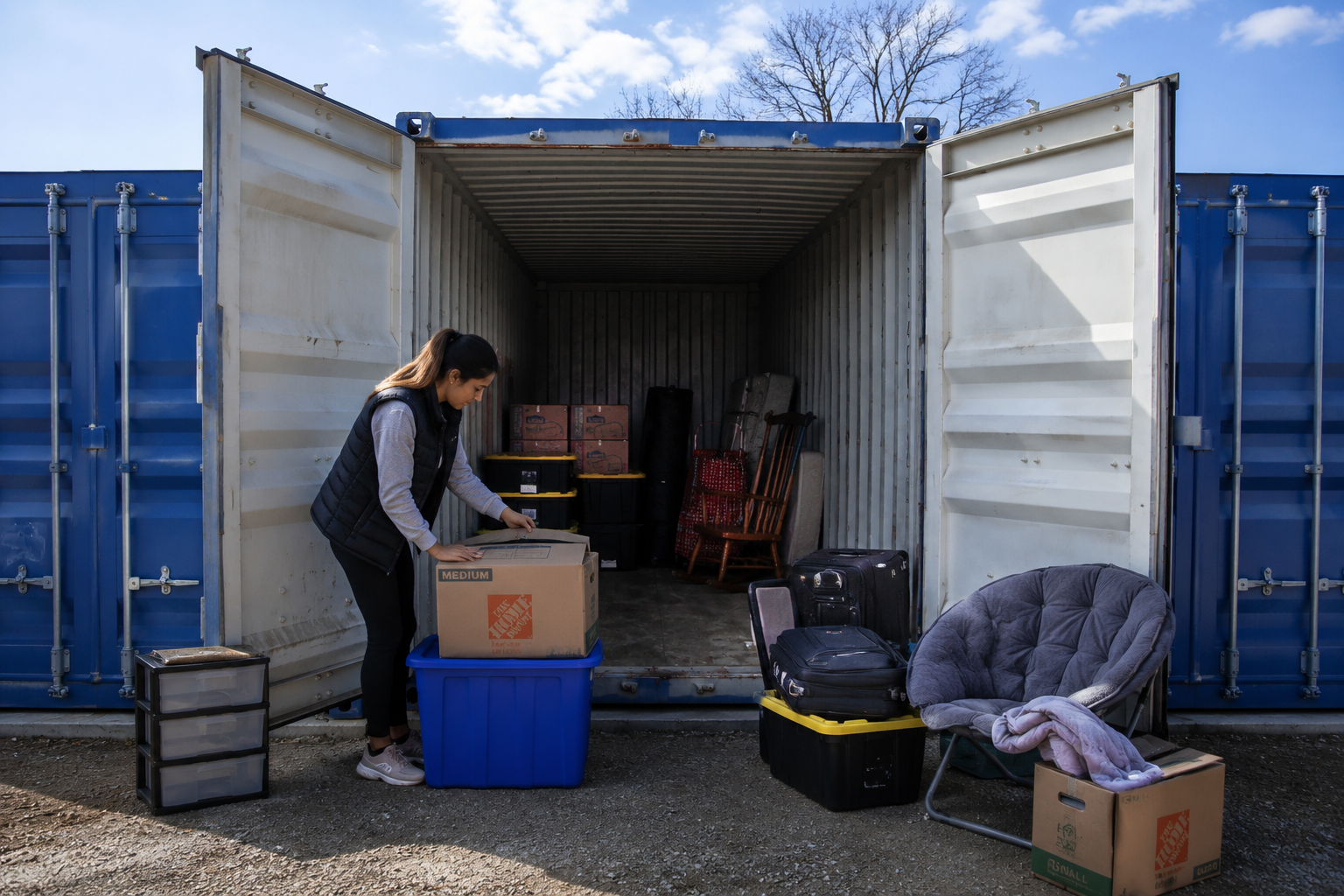
Storage Unit Moisture and Condensation: What Causes It and How Can You Reduce It?
Storage Unit Moisture and Condensation: What Causes It and How [...]
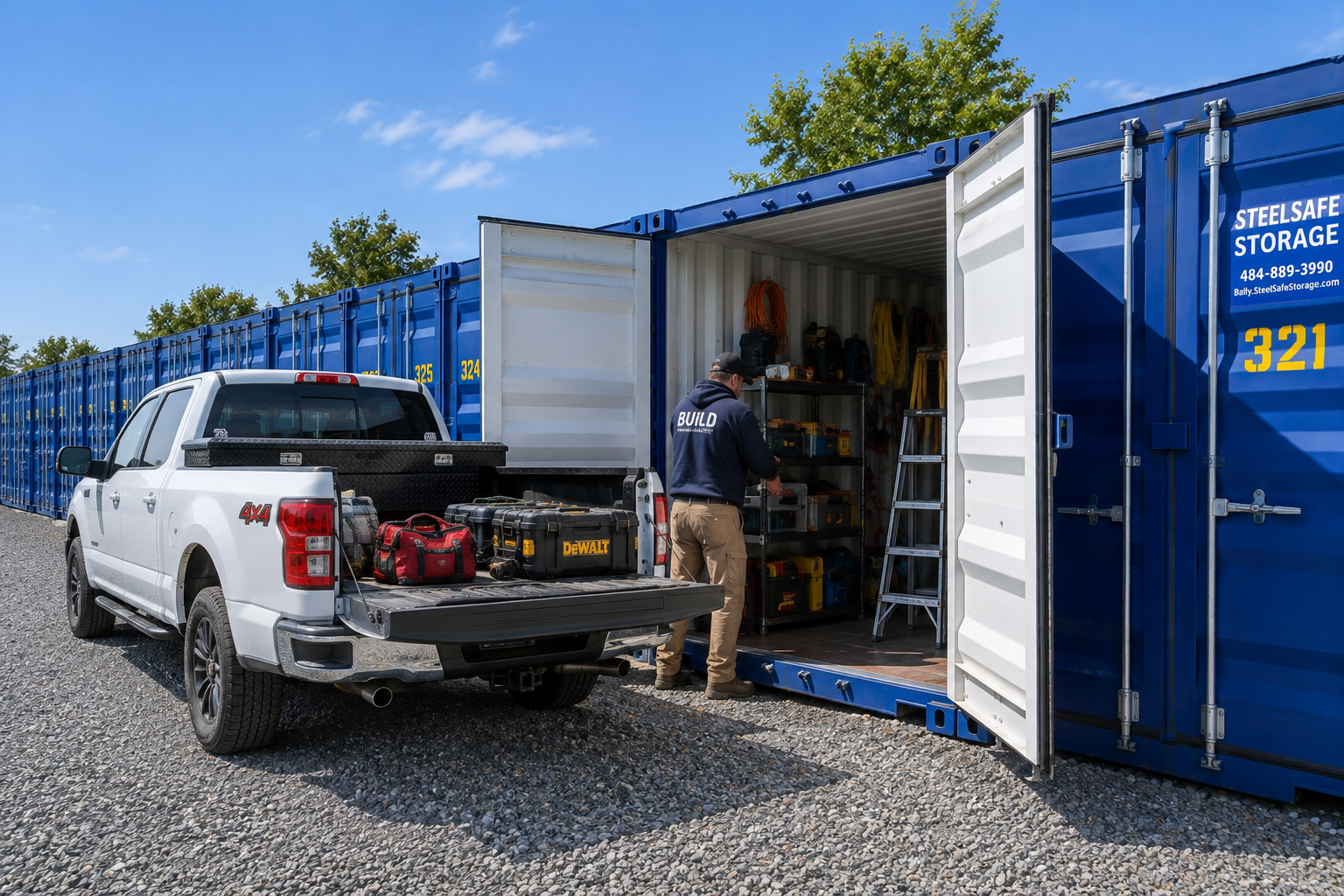
Drive-Up Storage: What Is It and Who Is It Best For?
Drive-Up Storage: What Is It and Who Is It Best [...]
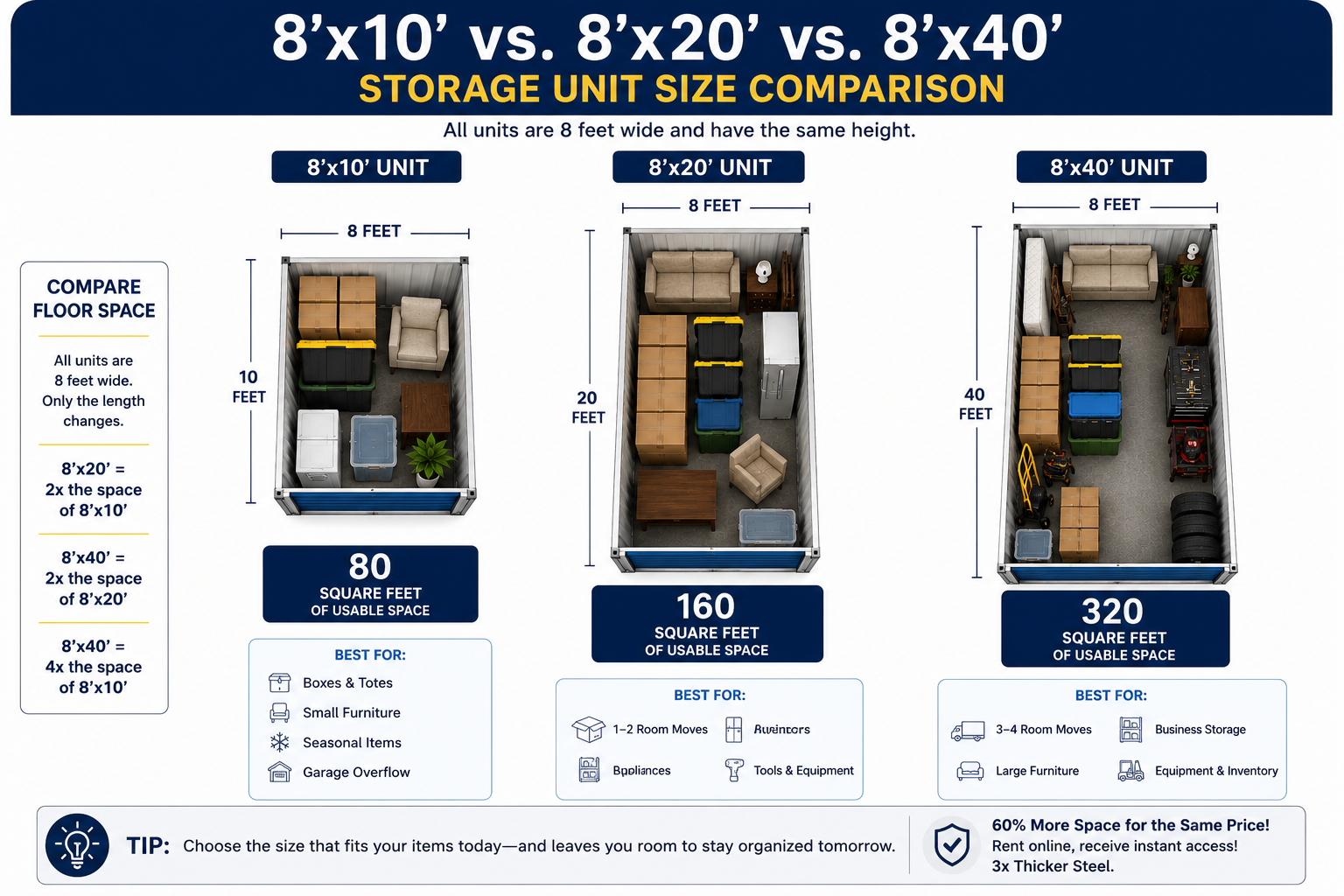
8×10 vs. 8×20 vs. 8×40 Storage Units: Which Size Do You Need?
8×10 vs. 8×20 vs. 8×40 Storage Units: Which Size Do [...]
What Fits in an 8×20 Storage Unit? See 60% More Floor Space
What Fits in an 8×20 Storage Unit? See 60% More [...]
Decluttering Without Pressure
How to Declutter Without Getting Rid of Everything Decluttering [...]