

8×10 vs. 8×20 vs. 8×40 Storage Units: Which Size Do You Need?
Choosing a storage unit can be confusing when all you have are dimensions. An 8×10, 8×20, and 8×40 may sound similar on paper, but the amount of floor space changes significantly between each size.
SteelSafe offers storage units in these sizes at select locations:
- 8×10 = 80 square feet
- 8×20 = 160 square feet
- 8×40 = 320 square feet
That means an 8×20 provides twice the floor area of an 8×10, while an 8×40 provides twice the floor area of an 8×20.
The right choice depends on what you’re storing, how much you have, and whether you want extra room to organize and access your belongings.
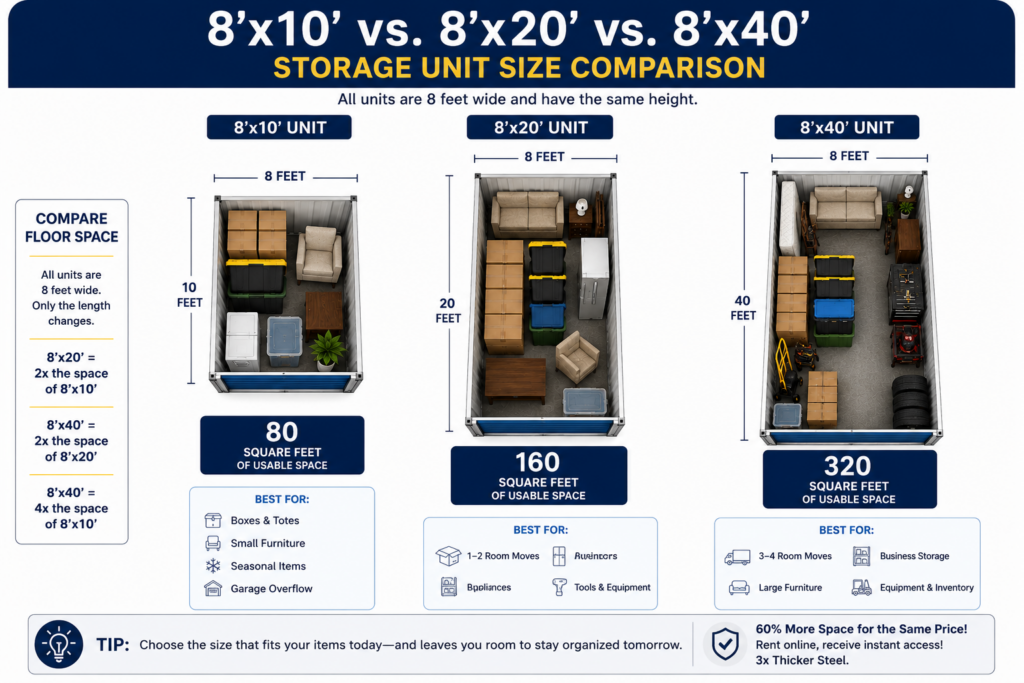
Compare the floor space of SteelSafe’s 8×10, 8×20, and 8×40 storage units.
How Much Space Does Each Storage Unit Provide?
The easiest way to understand the difference is to compare the floor area.
| Unit Size | Floor Space |
|---|---|
| 8×10 | 80 sq. ft. |
| 8×20 | 160 sq. ft. |
| 8×40 | 320 sq. ft. |
Going from an 8×10 to an 8×20 gives you an additional 80 square feet of floor space.
Going from an 8×20 to an 8×40 gives you an additional 160 square feet.
But choosing a unit isn’t simply about getting the most space. The goal is to find a size that gives you enough room for your belongings without renting more space than you need.
What Fits in an 8×10 Storage Unit?
At 80 square feet, an 8×10 is the smallest of the three sizes in this comparison.
It may be worth considering when you need storage for a more limited amount of belongings, such as boxes, totes, seasonal items, smaller furniture, household overflow, or business supplies.
An 8×10 may make sense when you’re decluttering your home or simply need some additional storage space.
How much it actually fits will depend on the dimensions and quantity of your belongings and how you arrange them.
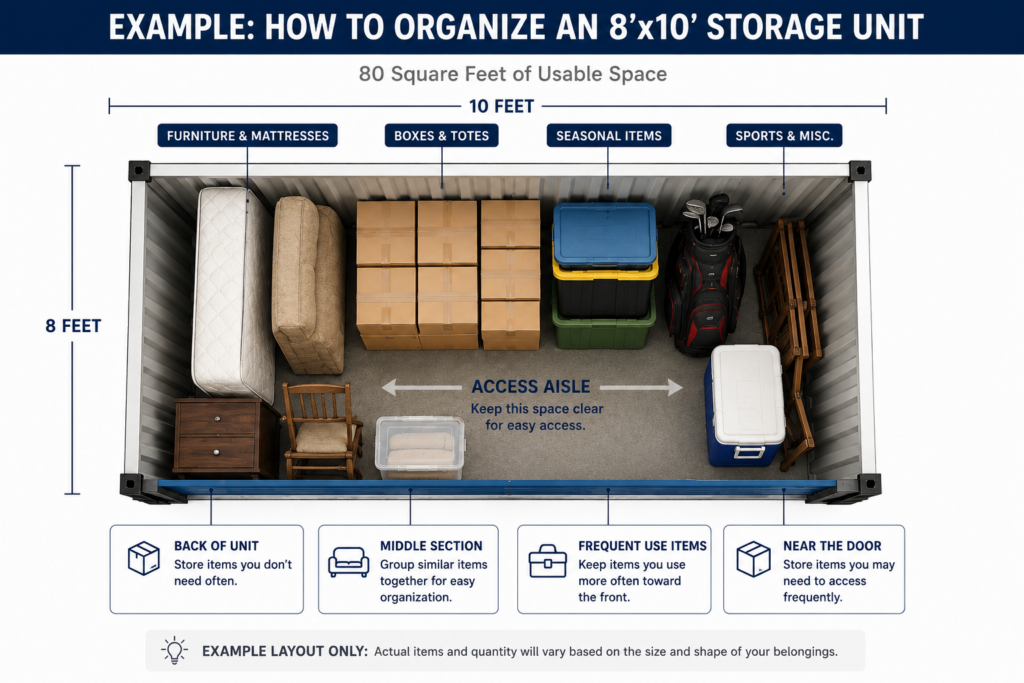
Example of how an 8×10 storage unit could be organized for household or overflow storage.
What Fits in an 8×20 Storage Unit?
An 8×20 provides 160 square feet of floor space, twice the floor area of an 8×10.
The additional room can provide more flexibility for furniture, appliances, moving boxes, storage totes, tools, equipment, seasonal belongings, or business inventory.
The longer layout can also help you organize belongings from front to back. Depending on how much you’re storing, you may be able to keep frequently used items closer to the entrance and leave an access aisle to belongings farther inside.
We have a complete guide showing this size in more detail:
What Fits in an 8×20 Storage Unit?
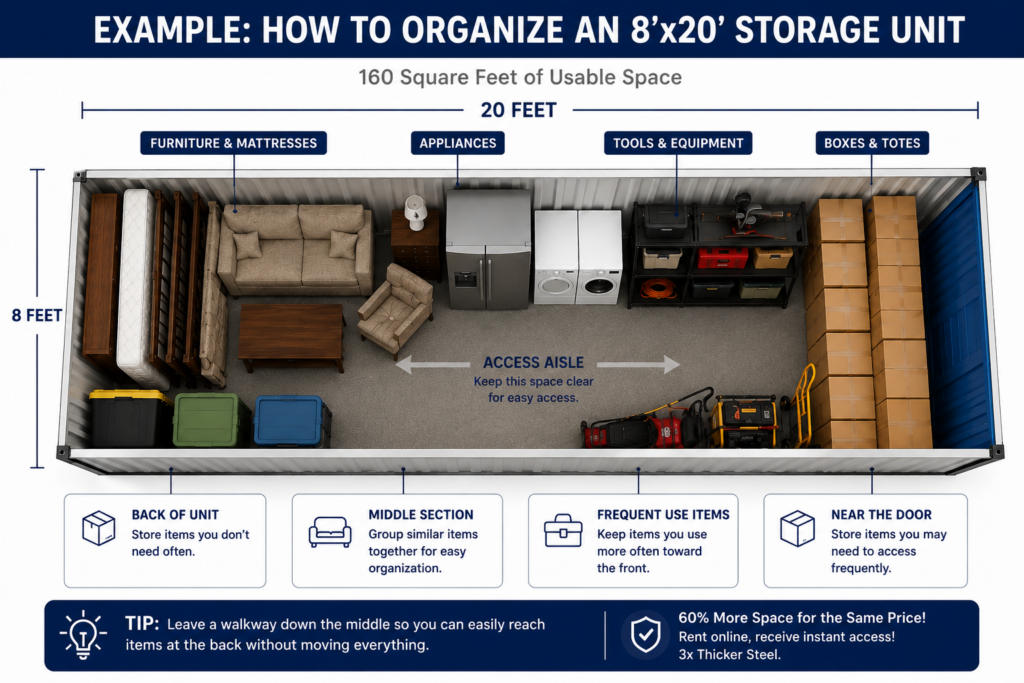
Example of how an 8×20 storage unit can be organized with furniture, appliances, tools, boxes, and a clear access aisle.
As with any storage unit, actual capacity depends on the size, shape, quantity, and arrangement of your belongings.
What Fits in an 8×40 Storage Unit?
An 8×40 provides 320 square feet of floor space—twice the floor area of an 8×20 and four times the floor area of an 8×10.
That additional room may be useful for customers with substantially more to store, including larger household storage needs, business inventory, tools, equipment, supplies, or a combination of different types of belongings.
For contractors and small businesses, a larger unit may also provide more flexibility to separate equipment, supplies, and inventory into different areas rather than placing everything together.
For residential customers, the additional floor space can provide more options when organizing furniture, appliances, boxes, and other household belongings.
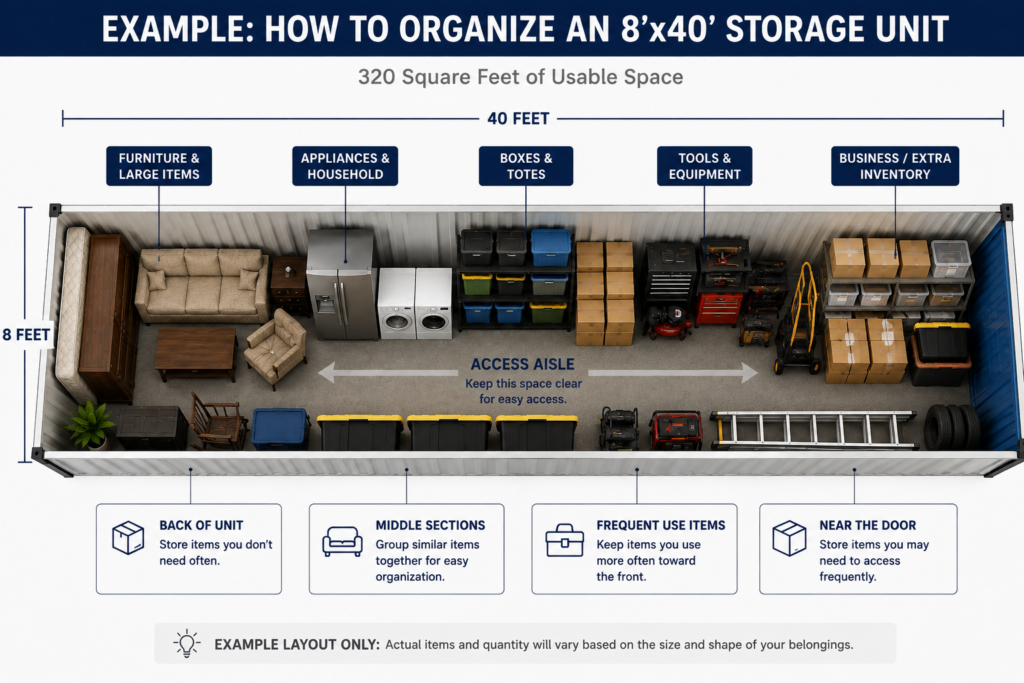
An 8×40 provides 320 square feet of floor space for larger storage needs.
These examples are intended as a guide rather than a capacity guarantee. The amount that fits depends on your individual belongings and how the unit is packed.
8×10 vs. 8×20 vs. 8×40: Which One Should You Choose?
Start with what you actually need to store rather than automatically choosing the largest unit.
An 8×10 may make sense if you have a smaller amount of household belongings, seasonal items, boxes, or business supplies.
An 8×20 gives you twice the floor area of an 8×10 and may be a better option when you’re storing more furniture, appliances, boxes, tools, equipment, or inventory.
An 8×40 provides the most floor space of the three and may be worth considering for larger-volume household, contractor, or business storage needs.
If you’re unsure, make a list of your largest belongings first. Furniture, appliances, equipment, and other bulky items will usually determine how much space you need more quickly than boxes will.
Then think about access. If you’ll need to retrieve belongings regularly, allowing some additional room for organization and an access aisle may be more useful than packing everything tightly from wall to wall.
Don’t Compare Storage Units by Price Alone
Monthly price matters, but it doesn’t tell you how much usable space you’re receiving.
When comparing storage options, consider:
- Total floor space
- The amount and size of your belongings
- How frequently you’ll need access
- Whether you want room for an access aisle
- Drive-up convenience
- Your expected storage period
A smaller unit may be all you need. In other situations, additional space may make it easier to keep belongings organized and accessible.
The best value is the unit that gives you the space and convenience you actually need—not simply the lowest advertised monthly price.
How to Get More From Your Storage Space
Whichever size you choose, a little planning can make the space easier to use.
Put heavier belongings toward the bottom and keep items you won’t need often farther back. Place frequently used items closer to the entrance.
Label boxes clearly and group similar belongings together so you know where to look later.
When space allows, leave an aisle rather than filling every available section of floor. That can make it easier to reach belongings toward the back without moving everything in front of them.
For additional help choosing a unit, visit the SteelSafe Storage Unit Size Guide.
Storage for Homeowners, Contractors, and Businesses
Different customers use storage differently.
Residential customers may need additional room during a move, renovation, downsizing project, or for seasonal and household overflow.
Contractors may need convenient space for tools, equipment, materials, and supplies.
Small businesses may use additional storage for inventory, equipment, records, or other business assets.
Customers storing household belongings can explore Residential Storage, while contractors and business owners can review Business Storage options.
Find the Right SteelSafe Storage Unit Near You
SteelSafe has multiple storage locations across Pennsylvania, New York, North Carolina, and Colorado.
Unit sizes vary by location, and not every SteelSafe facility offers all three sizes. Current internal facility information shows that available sizes differ by location.
Check your nearest facility to see which unit sizes are currently available, along with current pricing, promotions, access information, and rental options.
Not Sure Which Size to Choose?
Start by listing what you plan to store and identifying your largest items. Then compare that list with the available SteelSafe unit sizes.
You don’t need the biggest unit—you need the right amount of usable space for your belongings and the way you want to access them.
Ready to Reserve a Self Storage Unit?
Additional Resources
How to Prepare Seasonal Equipment for Storage in Granby, CO
How to Prepare Seasonal Equipment for Storage in Granby, CO [...]

What Size Parking Space Do You Need for a Trailer, Boat, or RV?
What Size Parking Space Do You Need for a Trailer, [...]
Garage Full? When a Storage Unit Makes More Sense Than More Shelving
Garage Full? When a Storage Unit Makes More Sense Than [...]
Built Differently: A Closer Look at What Makes a SteelSafe Storage Unit Stand Out
Built Differently: A Closer Look at What Makes a SteelSafe [...]

Need Storage Next Month? How SteelSafe’s Future Reservation Works
Need Storage Next Month? How SteelSafe’s Future Reservation Works You [...]
Is Your Work Trailer Costing You Time? When Contractors Should Consider a Storage Unit
Is Your Work Trailer Costing You Time? When Contractors Should [...]